
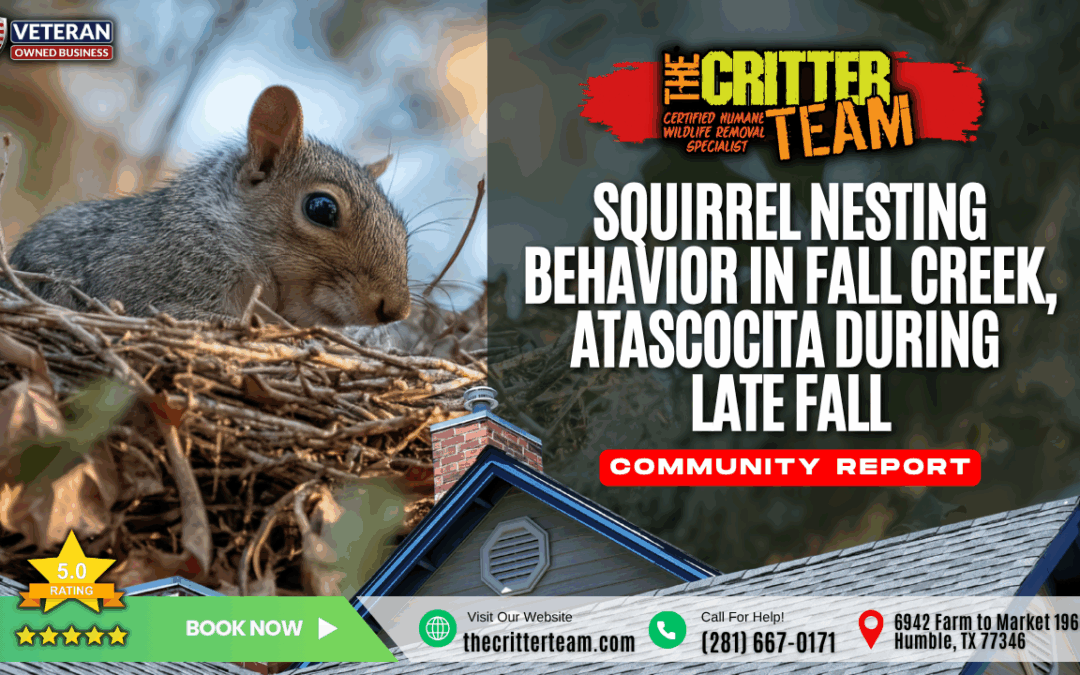
Squirrel Nesting Behavior in Fall Creek, Atascocita, TX During Late Fall
Short answer: by late fall, squirrels in Fall Creek have moved from outdoor leaf nests into attic cavities and are reinforcing their winter nests ahead of the late-winter litters. Eastern gray and fox squirrels gather insulation, paper, and chewed wood fibers into compact piles tucked against rafters and HVAC equipment. The behavior is most visible in the fall and early winter, which is also when most local attic infestations get established.
If you have heard daytime scratching above the ceiling or noticed nest material spilling out of a soffit cavity, the late-fall nesting cycle is already underway in your home.
We’ve handled Humble, TX squirrel trapping since 2015, and the crew knows which neighborhoods see the heaviest pressure and which entry points fail first on local homes.
How the Late Fall Nesting Cycle Works
Squirrels do not hibernate. They need a dry, insulated nest that holds heat through the coldest stretches of the Houston winter, and attic insulation is perfect for the job. The behavior follows a predictable arc:
- Late fall. Outdoor leaf nests become less reliable as cooler nights set in
- Fall. Squirrels test entry points on local rooflines and widen any starter gaps
- Mid to late fall. The bulk of the local population shifts indoors and begins building winter nests
- Early Winter. Females reinforce nests for the late-winter litters and the chewing damage compounds
Why Fall Creek Sees Heavy Squirrel Pressure
Fall Creek is a master-planned community on the eastern edge of Atascocita with mature pines, oaks, and a strong canopy that supports a year-round squirrel population. The two-story brick homes that make up most of the neighborhood have dormer-heavy rooflines and the typical wear points squirrels exploit. The trees give squirrels travel routes directly onto the rooflines, and the established canopy makes the climb unnecessary on most properties.
Mike Garrett, a retired U.S. military veteran, founded The Critter Team in 2015 and built it into a Humble wildlife control that runs every job in-house with its own trained technicians. No subcontractors, no handoffs.
Where the Nests Form Inside the Attic
Once inside, squirrels look for the warmest, most sheltered corner they can find:
- Tucked into roof valleys where two slopes meet
- Against chimney chases where the masonry holds residual heat
- In soffit cavities close to the entry point
- Around HVAC equipment for the radiant warmth
- Inside boxes and stored items when accessible
The nest itself is built from blown-in insulation, batt insulation paper, paper, fabric, and chewed wood fibers.
Important: By winter, females may already have a litter inside the nest. Sealing entry points before all of the animals are removed traps live young in the wall or attic. They die in the insulation and create odor and contamination problems worse than the original infestation. Inspection first, removal second, exclusion third. Always.
How Squirrels Get In
A grown squirrel only needs about a one and a half inch hole, and it will widen any starter gap with its teeth in a week or two. The most common entry points across Fall Creek homes:
- Soffit-to-roof transitions on dormers and second-story tie-ins
- Plastic and aluminum gable louvers with separated screen
- Plastic roof vents and turbine bases brittled by Texas heat
- Rotted fascia behind clogged gutters
- Construction gaps at chimney chase tie-ins
Hiring a squirrel trapping in Humble, Texas with hands-on experience changes the outcome. We fabricate 23-gauge aluminum on-site, match the paint to the home, and back every exclusion job with a written warranty covering one-year and three-year options.
Warning Signs of an Established Nest
- Daytime activity in the same spot every day
- Loose insulation pulled into a corner of the attic
- Visible nest material spilling out of a soffit cavity
- Chewed wiring with bare copper visible
- Yellow water staining on a ceiling from a chewed PVC line
- Damaged stored items in the attic
- Heavy musk odor in the attic near the nest site
What the Damage Adds Up To
The Texas A&M AgriLife extension documents that tree squirrels in Texas are responsible for a significant share of attic-related damage. Stripped wires create fire risk, chewed PVC water lines leak, and HVAC ductwork loses efficiency as the chewing compounds.
What a Real Squirrel Job Looks Like
We handle squirrel work as a complete sequence:
- Full inspection. Attic, every roofline transition, every vent and penetration. Photos of every entry point and every sign found. The crew also looks for kits.
- Humane removal. One-way exclusion doors at the active entry point allow squirrels to leave without coming back in. Hand removal of kits where appropriate. No poison and no kill traps.
- Exclusion work. Every opening sealed with materials that hold up to chewing, including fabricated 23 gauge aluminum on roofline transitions. No spray foam and no steel wool.
- Decontamination. Nest material removed, contaminated insulation pulled and replaced, framing sanitized.
- Written warranty. One-year and three-year warranty options on the exclusion work.
Every phase is handled in-house by our own trained technicians, from the initial inspection through the warranty-backed exclusion. No subcontractors touch the job.
What You Can Do This Week
Trim limbs at least three feet back from the roof on every side.
Pick up fallen pecans, acorns, and ornamental fruit on a schedule.
Pull bird feeders or move them to a baffled pole away from the structure.
Replace plastic roof vents with the heavier galvanized powder-coated versions.
Inspect fascia and soffit twice a year for fresh chew marks.
If you’re looking for Humble, Texas squirrel removal, contact The Critter Team in Humble, Texas today at (281) 667-0171
The Critter Team
6942 FM 1960 Rd E, Suite 211
Humble, TX 77346
(281) 667-0171

📍 Atascocita, Humble, TX
Call today if you are in need of a Atascocita, Humble squirrel removal
The Critter Team
6942 FM 1960 Rd E, Suite 211
Humble, TX 77346
(281) 667-0171
Check out our other squirrel related articles:
Squirrel fall activity Elm Grove Village Kingwood, TX & Squirrel fall behavior Deerbrook Estates Humble, TX
Frequently Asked Questions
How can I tell if a squirrel has built a nest in my attic?
Look for daytime activity in the same spot every day, peaking at sunrise and before sunset. Loose insulation pulled into a corner and a heavy musk odor near the entry point are reliable signs. Pet behavior, especially cats fixating on a single ceiling spot, often points directly at the nest location.
Why does the late Fall nesting cycle hit Fall Creek harder than some other neighborhoods?
The mature pine and oak canopy across Fall Creek supports a strong year-round squirrel population, and the trees give the animals ideal travel routes onto local rooflines. The combination of food, cover, and easy roof access concentrates squirrel activity in the neighborhood every fall.
Can I just block the entry point and let the squirrels leave on their own?
No. Sealing the entry point before the animals are out traps the squirrels and any kits inside the attic. They die in the insulation and create an odor and contamination problem worse than the original infestation. The right sequence is one-way exclusion at the active entry point, removal of any kits, and then full sealing once every animal is out.
What is the connection between Fall nesting and Winter litters?
Squirrels in the Houston climate produce litters in late winter and again in late summer. Females reinforce their winter nests through fall and winter ahead of the late winter litters. This is why squirrel removal in late fall and early winter so often involves a litter on the way.
How long does the work take in Fall Creek?
For a typical home with a moderate infestation, removal and exclusion runs about one to two weeks from the first visit. If a litter is present, the timeline depends on the age of the kits. Decontamination and insulation replacement add a few more days.