
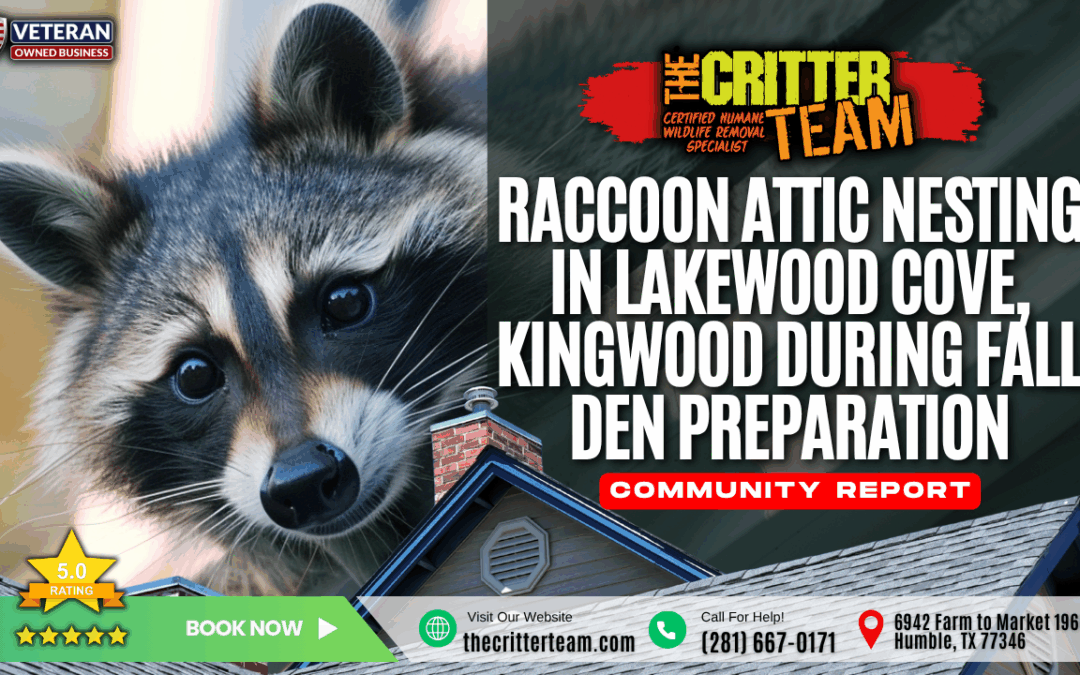
Raccoons Nesting in Lakewood Cove Attics During Fall Den Season
Lakewood Cove, a wooded subdivision in Kingwood, Houston, is prime raccoon territory. Big lots, heavy canopy, older roofs, and a greenbelt running along the back of the neighborhood give raccoons everything they need to move around freely. Fall is when they start looking for a warm, dry, elevated place to spend the winter, and that is when they end up in attics.
The short answer: a raccoon in your attic during fall is almost always a female scouting a winter den, and in many cases she is either already carrying kits or raising them in place. We offer raccoon trapping company in Humble, TX. Our trained crews know the local construction patterns and the entry points that raccoons target on every style of home in the area. Attics mimic a hollow tree but with better insulation and no weather. Once she settles in, she will tear up insulation, damage ductwork, foul the space with urine and droppings, and chew on anything in reach including wiring. The job needs to be handled quickly and in the right order: remove, exclude, clean up, warranty.
Why Raccoons Target Attics in Fall
They need a winter den, not a temporary shelter. In the wild, a raccoon would pick a hollow tree cavity, a rock crevice, or an old burrow. In Lakewood Cove, an attic beats all of those. It is dry, insulated, elevated, dark, and it has multiple entry options.
Kits are part of the picture. Raccoons breed from late winter into early spring in Texas, and fall den scouting often overlaps with females still caring for young from the current year. That is why raccoon removal in fall usually involves more than one animal.
They return to what works. If a raccoon successfully used an attic last winter, she will come back. If her mother used that attic, there is a good chance she learned the route. Exclusion has to be permanent, not a quick patch.
Signs You Have a Raccoon in Your Attic
- Heavy thumping and rolling sounds overhead after dark, much louder than a rat or squirrel
- Vocalizations, especially chattering, growling, or the high whining sounds of kits
- Torn or displaced insulation pushed into a nest shape, often near a wall or chimney chase
- Large droppings concentrated in one spot, which is called a raccoon latrine
- Strong urine smell starting to bleed through the ceiling below
- Ripped soffit, torn roof vents, bent flashing, or a hole in the fascia large enough to fit your hand
- Greasy smudge marks on siding or gutters along the approach route
If you see any two of these together, you have a raccoon, and waiting does not make it better. Mike Garrett, a retired U.S. military veteran, founded The Critter Team in 2015. We’ve dispatched crews to Kingwood for over a decade and cover this neighborhood and the surrounding communities with in-house technicians who handle every phase of the job.
The Real Risks of Letting It Go
Structural Damage
Raccoons are strong enough to tear through drywall, rip up roof decking from below, and chew large holes through soffit and fascia. A fall-to-spring occupation in a single attic can easily run into thousands of dollars of damage to insulation, ductwork, and wiring.
Health and Contamination
Raccoon droppings can carry Baylisascaris procyonis, a parasitic roundworm with eggs that stay viable in the environment for years and spread through contact with raccoon feces. Raccoons also carry the risk of rabies, which is another reason DIY removal is a bad idea.
Fire Risk
Raccoons chew on things, and wire insulation is a common target. Chewed wiring is a recognized contributor to attic electrical fires. If you see flickering lights or smell anything burning after noticing raccoon activity, treat it as urgent.
Important: Never seal a hole before the raccoon is out, and never seal one during the time of year when kits are likely present. A mother raccoon sealed away from her young will tear through another part of the house to reach them, and kits sealed in will die in the insulation. Proper removal starts with inspection, not patching.
How the Job Gets Done Properly
- Thorough inspection. We check the attic, roofline, and exterior walls. We identify the active entry, count animals, and confirm whether kits are present.
- Humane removal. We use live trapping on the entry, hand removal of kits where needed, and release at an appropriate distance from the property.
- Exclusion. We close the entry with fabricated 23-gauge aluminum, reinforce vulnerable roof-to-soffit transitions, and cover roof vents with galvanized powder-coated covers. We do not use spray foam for this work because it fails quickly in Houston heat.
- Attic cleanup and decontamination. We remove soiled insulation, sanitize exposed framing, and replace insulation where needed. Full PPE is used because raccoon latrines carry real health hazards.
- Damage repair. We handle fascia, soffit, and drywall repairs in-house by the same technicians, not subcontracted to a roofer.
- Written warranty. Every exclusion job carries a written warranty, with one-year and three-year options depending on scope.
Long-Term Prevention in Lakewood Cove
Trim back overhanging branches. Raccoons jump and climb from trees within about 8 to 10 feet of the roofline. Cutting branches back is the single biggest prevention step.
Cap the chimney. An open chimney is a natural den for a raccoon. A proper stainless steel chimney cap with animal-proof mesh closes that option off entirely.
Cover roof vents and secure soffit. Brittle plastic vents and loose fascia are the two most common entry points raccoons use in Lakewood Cove. Replacing them with fabricated metal stops the problem before it starts.
Lock down food sources. Secure trash lids, bring pet food in at night, and remove loose bird seed. A raccoon with no reason to come into the yard usually moves on to the next block.
If you are looking for raccoon removal company in Humble, TX, contact The Critter Team in Lakewood Cove, Texas today at (281) 667-0171
The Critter Team
6942 FM 1960 Rd E, Suite 211
Humble, TX 77346
(281) 667-0171

📍 Lakewood Cove, Humble, TX
Call today if you are in need of a raccoon trapping services in Lakewood Cove, Humble, TX
The Critter Team
6942 FM 1960 Rd E, Suite 211
Humble, TX 77346
(281) 667-0171
Check out our other raccoon related articles:
Raccoon nocturnal behavior Sherwood Trails Kingwood, TX fall and raccoon den sites Kings Forest Estates Kingwood fall preparation
Frequently Asked Questions
How do I know if there are baby raccoons in my attic?
Listen for soft whining or chittering sounds during the day, which is when kits are most vocal while the mother is resting. You may also hear thumping from the mother moving around them. If you hear multiple distinct sound sources, assume there are young and do not attempt removal yourself. The job requires hand removal of kits paired with the mother.
Can I just use a live trap to catch a raccoon myself?
Legally it is complicated in Texas, and practically it almost always fails. A trap outside may catch the mother while the kits stay in the attic and starve. Even if you catch her, the entry point is still open for the next raccoon. This is a job for a licensed wildlife control operator who handles removal and exclusion together.
Will the damage be covered by my homeowner’s insurance?
That depends on your policy. Many policies exclude wildlife damage as a maintenance issue, while others cover sudden damage like chewed wiring or torn ductwork. Document everything with photos before repair and ask your insurer directly. We are not able to give advice on what your specific policy will or will not cover.
How dangerous are raccoon droppings in an attic?
Serious enough to warrant professional cleanup. Raccoon feces can carry a roundworm called Baylisascaris procyonis, with eggs that remain infective for years. Decontamination should be handled with full PPE and proper disposal procedures, not a shop vac and a trash bag.
How long does a raccoon removal job usually take?
Initial trapping and removal typically runs one to two weeks. If kits are present or the entry requires fabricated metal repair, the timeline extends. Attic cleanup, insulation replacement, and drywall repairs add additional days depending on the extent of damage. Every exclusion phase is backed by a written warranty.
What keeps raccoons from coming back next year?
Permanent exclusion. The entry point and every other vulnerable spot on the roofline get sealed with materials raccoons cannot get through, which means fabricated metal and galvanized vent covers, not spray foam or plastic. Combined with food source management and trimmed branches, that is what ends the problem for good.