
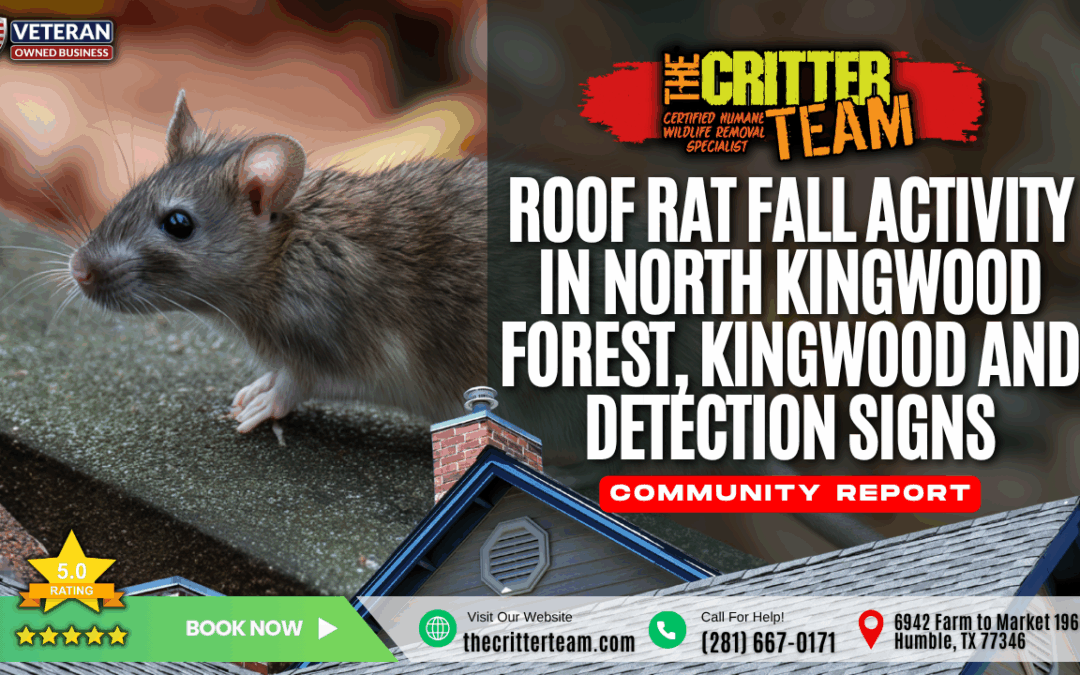
Roof Rat Fall Activity in North Kingwood Forest and How to Spot It Early
If you live in North Kingwood Forest, a subdivision of Kingwood in northeast Houston, fall is when roof rat calls start rolling in. As nighttime temperatures drop and acorn and pecan mast hits the ground, rats that have been living high in the trees start looking for warmer, drier nesting spots. Attics, soffit gaps, and wall voids are exactly what they are looking for.
The short answer: if you hear scratching overhead after dark, find dark pellet droppings in the garage or attic, or notice chew marks on soft fascia and roofline wood, you most likely have roof rats moving in for the season. Catching it in the first week or two makes the job a lot smaller.
We have worked roof rat control jobs across Kingwood since 2015, and our crew knows which neighborhoods see the heaviest pressure and which entry points fail first on local homes.
Why Roof Rat Activity Picks Up in the Fall
Cooler nights push rats indoors. Roof rats (Rattus rattus) are tree-dwelling climbers by preference. When overnight lows start dipping into the 50s around Kingwood, the warm, insulated cavity of a residential attic becomes a much better nest than an oak crown.
Food gets easier to find close to houses. Fall is when pecans, acorns, and ornamental fruit drop, and that pulls rats out of the woods along Kingwood’s greenbelts and into backyards. Bird feeders, uncovered pet bowls, and loose trash lids finish the job of drawing them to the structure.
Once they find a warm attic with food nearby, they settle in fast. A pair of roof rats can turn into a dozen in a season, with roof rat biology supporting litter sizes of 5 to 8 pups and multiple litters per year.
Signs Roof Rats Are Already In Your Kingwood Home
Roof rats are secretive. Most homeowners don’t see the animal, they see the evidence. Here is what to look for in North Kingwood Forest homes:
- Droppings: dark, shiny pellets about a half inch long with pointed ends. Fresh ones look wet. Rat droppings scatter along travel paths, not in one pile.
- Gnaw marks: clean, chisel-like bites on fascia edges, plastic ridge vents, PVC water lines, and attic wiring insulation.
- Greasy rub marks: dark smudges along rafters, pipes, and the tops of wall plates where the same body oil gets deposited every night on a repeated route.
- Shredded insulation: little tunnels and troughs pushed through blown-in attic insulation, often with seed husks or pecan fragments mixed in.
- Night noise: scratching, scurrying, and gnawing sounds after dark, usually concentrated along one section of the ceiling.
How Rat Droppings Compare to Other Attic Pests
A common mistake is confusing rat droppings with squirrel or bat sign. Squirrel pellets are rounder and usually tan or light brown when fresh. Bat guano is dull, crumbles between your fingers, and often piles up in one concentrated spot. Rat pellets are darker, elongated, and scattered wherever the animal traveled.
Mike Garrett and our crew find the wrong animal already identified on roughly a third of the attic jobs we inspect in the Kingwood area. A thorough look often reveals more than one species using the same entry.
Our founder Mike Garrett, a retired U.S. military veteran, started The Critter Team in 2015. We run every job in-house with our trained technicians. No subcontractors, no handoffs.
How Roof Rats Get Into Houses in North Kingwood Forest
Kingwood homes have a few structural features that make them popular with roof rats. Heavily treed lots put branches within climbing range of the roof. Asphalt shingle transitions where a second story ties into a first story leave small gaps behind the flashing. And the humid, hot climate softens wood fascia and soffit edges faster than in drier parts of Texas.
The most common entry points we see on local jobs:
- Gaps where the soffit meets the roof deck, especially on dormer and gable transitions
- Weep vents and plumbing penetrations through brick veneer
- Loose or chewed plastic roof vents and turbine bases
- AC line chases where foam collar has shrunk or fallen away
- Rotted fascia board behind gutters that stayed full of leaves
Any gap bigger than a dime is a potential roof rat door. The animal’s skeleton compresses through openings that look impossibly small.
Important: If you seal a hole before the rats are out, you trap them inside the wall or attic. Dead rats in insulation become an odor and decontamination problem that is far worse than the original infestation. Always remove the animals first, then exclude.
What Attracts Roof Rats to Your Yard
Most roof rat infestations start outside. Cleaning up the yard removes the reasons a rat came shopping in the first place.
- Unpicked fruit and fallen pecans. Rats will work a productive tree every night until it is stripped.
- Bird seed and spilled seed under feeders. A feeder on a shepherd’s hook over bare soil is essentially a rat cafeteria.
- Pet food and water left outside overnight.
- Open compost piles and loose trash lids.
- Tree branches that touch the roof or hang over it within three feet.
- Ivy, star jasmine, and other climbing vines on exterior walls.
Our Kingwood, Texas roof rat removal services provide hands-on experience that changes the outcome. We fabricate 23-gauge aluminum on-site, match the paint to the home, and back every exclusion job with a written warranty covering one-year and three-year options.
What To Do If You Already Have Roof Rats
Roof rats are not a problem you outwait. Every week you leave it alone, you get more rats, more droppings in the insulation, and more damage to wiring and ductwork. The fix is the same sequence every time:
- Full interior and exterior inspection. Attic, foundation line, roofline, every vent and penetration. Photos of every entry point found.
- Trapping on the active runs. We use humane live and snap methods, never poison and never kill traps that pose risks to pets or non-target wildlife.
- Exclusion work. Seal every opening with rodent-proof materials like copper mesh, galvanized hardware cloth, and fabricated 23 gauge aluminum on roofline transitions.
- Decontamination. Vacuum soiled insulation, sanitize exposed framing, and replace contaminated batts or blown-in material.
- Warranty. Every exclusion job done by The Critter Team carries a written warranty, with one-year and three-year options depending on scope.
We do all of this in-house. The same crew that inspects your attic also handles trapping, fabricates the exclusion metal, and performs the cleanup. No subcontractors walking through your house.
Long-Term Prevention After the Rats Are Out
Seal small openings with the right material. The company does not use spray foam as a standalone seal. In the Houston heat it turns brittle within about a year, and rats chew through softened foam without any trouble. Copper mesh backed with sealant, galvanized hardware cloth, and fabricated metal last.
Trim back the climbing routes. Keep tree limbs at least three feet off the roof. Clear vines off the walls. If oaks are too close to the house to cut, physical metal baffles around trunks can help.
Clean up the yard on a schedule. Pick up fallen fruit and nuts, pull bird feeders at night, store pet food indoors, and lock down the trash lids.
Health Concerns Worth Knowing About
Roof rats can spread disease through droppings, urine, and direct contact. The CDC lists several diseases directly transmitted by rodents that are relevant to the Gulf Coast, including leptospirosis and rat bite fever. Urine-contaminated insulation in an attic does not stay contained. Soffit vents and attic ladders let air move between the attic and the living space, which is why cleanup matters even when the attic is “not used.”
If the signs described above match what you are seeing, give us a call. We can inspect the property and start the removal process before the damage compounds.
If you are looking for roof rat trapping in Humble, TX, contact The Critter Team in Humble, Texas today at (281) 667-0171
The Critter Team
6942 FM 1960 Rd E, Suite 211
Humble, TX 77346
(281) 667-0171

📍 North Kingwood Forest, Kingwood, TX
Call today if you are in need of a North Kingwood Forest, Humble, Texas roof rat trapping service
The Critter Team
6942 FM 1960 Rd E, Suite 211
Humble, TX 77346
(281) 667-0171
Check out our other roof rat related articles:
Roof rat den sites Forest Cove Kingwood, TX fall & Roof rat infestations Kingwood Greens Kingwood, TX fall
Frequently Asked Questions
How can I tell if I have roof rats versus Norway rats in Kingwood?
Roof rats are the dominant rat species in Kingwood and most of the Houston area. They are slender, dark, and climb into attics and treetops. Norway rats are heavier, stay closer to the ground, and burrow near foundations or under slabs. If the noise is overhead and the droppings show up in the attic, it is almost always roof rats.
Why do roof rats show up more in Fall than summer?
Two reasons. First, cooler nights push them to find warmer shelter, and an attic is ideal. Second, fall is when pecans, acorns, and ornamental fruit drop around Kingwood yards, giving rats a reliable food source right next to houses. The combination of shelter and food pulls them off the greenbelts and into the neighborhood.
Is it safe to just trap them myself with store-bought traps?
A few traps might knock down the population briefly, but it rarely solves the infestation. Without identifying every entry point and sealing the structure, new rats replace the ones you catch within a week or two. DIY trapping also tends to “educate” survivors, which makes them harder to catch later.
Can I seal the entry points myself?
You can attempt it, but the materials matter. Steel wool rusts and falls apart in Houston humidity. Spray foam gets chewed through. Expanding plastic and fabric flashing fail fast. Durable exclusion uses copper mesh, galvanized hardware cloth, and fabricated metal, installed after the rats are removed, not before.
How long does roof rat removal usually take?
For a typical North Kingwood Forest home with a moderate infestation, initial trapping and entry point sealing takes about one to two weeks from the first visit. Attic decontamination and insulation replacement, when needed, add a few more days. Badly infested attics or multi-species jobs run longer.
What health risks do roof rats pose to my family?
Rats can carry bacteria and parasites that affect people through contact with droppings, urine, and contaminated surfaces. The CDC lists several rodent-borne illnesses including leptospirosis, salmonellosis, and rat bite fever. Most residential risk comes from urine and droppings in attics, which is why cleanup is part of a complete job.