
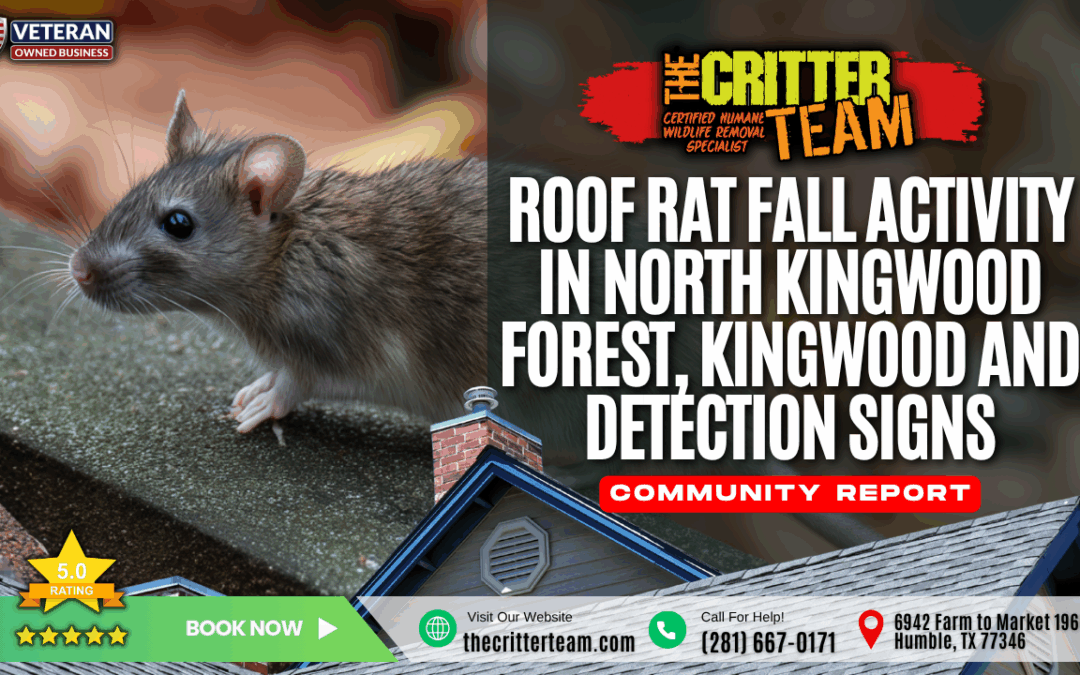
Roof Rat Infestations in Kingwood Greens, Kingwood, TX During Fall Cold Weather
Short answer: roof rats in Kingwood Greens move indoors as the first cold fronts of fall settle in, and the infestation pattern follows the weather closely. The colony shifts from outdoor nesting in trees and dense vegetation to attic cavities, soffit voids, and wall spaces inside local homes. Once indoor temperatures stay reliably warmer than outside, the rats commit to the new den site and breeding accelerates. Fall is when most Kingwood Greens infestations begin, and the contamination footprint grows fast from there.
If you have heard nighttime scratching above the ceiling, found droppings along a top plate, or noticed greasy rub marks along a rafter, the cold-weather move indoors has already happened on your property. We handle Kingwood, TX roof rat removal services calls across Kingwood with trained crews who know the local construction patterns and the entry points that roof rats target on every style of home in the area.
Why Cold Weather Drives the Move Indoors
Roof rats are warm-weather animals at heart, and they cannot maintain body temperature through extended cold nights without sheltered warmth. The fall cold fronts trigger a predictable behavioral shift:
- Outdoor nest sites in palm fronds, ivy, and tree cavities are abandoned as nighttime temperatures fall
- Indoor cavities with attic insulation and ductwork hold heat through the coldest nights
- The colony concentrates around chimney chases and HVAC equipment for the radiant warmth
- Breeding accelerates as the indoor environment stabilizes
Why Kingwood Greens Sees Heavy Pressure
Kingwood Greens sits along the golf course in one of the more wooded sections of Kingwood, with mature pines, oaks, and dense ornamental landscaping that supports a strong year-round roof rat population. The two-story brick homes that fill the neighborhood have dormer-heavy rooflines, and the established trees give rats elevated travel routes onto the rooflines themselves. The combination of cover, food, and structure-to-cover ratio is exactly what supports a fall infestation cycle.
Mike Garrett, a retired U.S. military veteran who founded The Critter Team in 2015, has dispatched our crews to Kingwood for over a decade. We cover this neighborhood and the surrounding communities with in-house technicians who handle every phase of the job.
Where the Colony Goes Inside the Attic
- Tucked into roof valleys where two slopes meet
- Against chimney chases where masonry holds residual heat
- In soffit cavities close to the entry point
- Around HVAC equipment for the radiant warmth
- On top of duct runs where the warm surface attracts the colony
- Inside insulation tunnels the rats have built themselves
The Eight Entry Points That Account for Most Local Jobs
- Soffit-to-roof transitions on dormers and second-story tie-ins
- Plastic roof vents and turbine bases brittled by Texas heat
- Gable louvers with separated screen
- Brick weep vents, dime-sized openings before any modification
- AC line chases where the foam collar has shrunk
- Plumbing stack boots with cracked rubber from UV exposure
- Garage door bottom seals worn at the corners
- Rotted fascia behind clogged gutters
Important: Sealing entry points before the rats are removed traps them inside the wall or attic. Dead rats in insulation become an odor and decontamination problem far worse than the original infestation. Removal first, exclusion second. Always.
This is where hiring a professional roof rat removal company makes a difference. Our technicians are Ridge Guard certified and hold Advanced Metal Fabrication certifications, which means the exclusion materials are purpose-built for the structure rather than improvised on the spot.
What Happens After the Colony Settles In
- Travel paths develop with greasy rub marks along rafters and wall plate tops
- Insulation gets pulled into corners and shredded for bedding
- Food caches appear near the den site
- Breeding accelerates with fast generational turnover
- Wiring damage compounds as the rats chew constantly
Health Concerns From an Established Colony
The CDC documents several diseases directly transmitted by rodents, including leptospirosis and salmonellosis. Both spread through droppings, urine, and contaminated surfaces. The longer the colony stays inside, the larger the contamination footprint becomes and the more involved the cleanup phase has to be.
What a Real Roof Rat Job Looks Like
We handle roof rat work as a complete sequence:
- Full inspection. Attic, foundation line, roofline, every vent and penetration. Den sites and travel paths identified and documented.
- Trapping on the active runs. Humane live and snap methods placed where the rats actually travel. No poison and no kill traps.
- Exclusion work. Every opening sealed with rodent-proof materials including copper mesh, galvanized hardware cloth, and fabricated 23-gauge aluminum on roofline transitions. No spray foam and no steel wool.
- Decontamination. Soiled insulation removed, framing sanitized, contaminated batts replaced.
- Written warranty. One-year and three-year warranty options on the exclusion work.
We have run this work in-house since 2015. The same crew that inspects the attic does the trapping, fabricates the metal on-site, and handles the cleanup. No subcontractors and no handoffs between companies.
What You Can Do Now
Trim limbs back at least three feet from the roof.
Pull bird feeders at dusk or move them to a baffled pole away from the structure.
Pick up fallen pecans, acorns, and ornamental fruit.
Replace plastic roof vents with the heavier galvanized powder-coated versions.
Latch trash lids instead of bungee-cording them.
If you are seeing any of the signs described above, we can inspect the property and start the removal process before the damage compounds.
If you are looking for Humble, Texas roof rat control, contact The Critter Team in Kingwood Greens, Humble, Texas today at (281) 667-0171
The Critter Team
6942 FM 1960 Rd E, Suite 211
Humble, TX 77346
(281) 667-0171

📍 Kingwood Greens, Humble, TX
Call today if you are in need of a Kingwood Greens, Humble, Texas roof rat trapping services
The Critter Team
6942 FM 1960 Rd E, Suite 211
Humble, TX 77346
(281) 667-0171
Check out our other roof rat related articles:
Roof rat fall activity North Kingwood Forest Kingwood, TX & Roof rat infestations Imperial Oaks Village behavior
Frequently Asked Questions
Why do roof rats move indoors specifically in fall?
They cannot maintain body temperature through extended cold nights without sheltered warmth. The first cold fronts trigger a behavioral shift, with outdoor nests in palm fronds, ivy, and tree cavities abandoned in favor of attic cavities, ductwork areas, and chimney chases that hold heat through the coldest nights.
How quickly does an indoor colony establish?
The first week or two looks similar to scouting behavior. By weeks three and four, travel paths develop with greasy rub marks, nest construction picks up, food caches appear, and breeding accelerates. By the time most homeowners hear the noise, the colony is already in the established phase.
Is poison a faster fix than trapping?
No, and the trade-offs are not worth it. Poisoned rats die in the wall and attic cavities, which creates serious odor and decontamination problems. Poison also moves up the food chain to pets, owls, and hawks that catch the affected rats. Trapping with proper exclusion is the durable approach.
Will the rats leave on their own when spring comes?
No. Once a colony has established an indoor den site with caches and an active breeding cycle, the rats stay year-round. The indoor environment is more stable than outdoor conditions, and the colony continues to grow until the entry points are sealed and the active animals are trapped out.
How long does the work take in Kingwood Greens?
For a typical home with a moderate infestation, initial trapping and entry point sealing takes about one to two weeks from the first visit. Decontamination and insulation replacement, when needed, add a few more days. Heavily infested attics or jobs with multiple species run longer.