
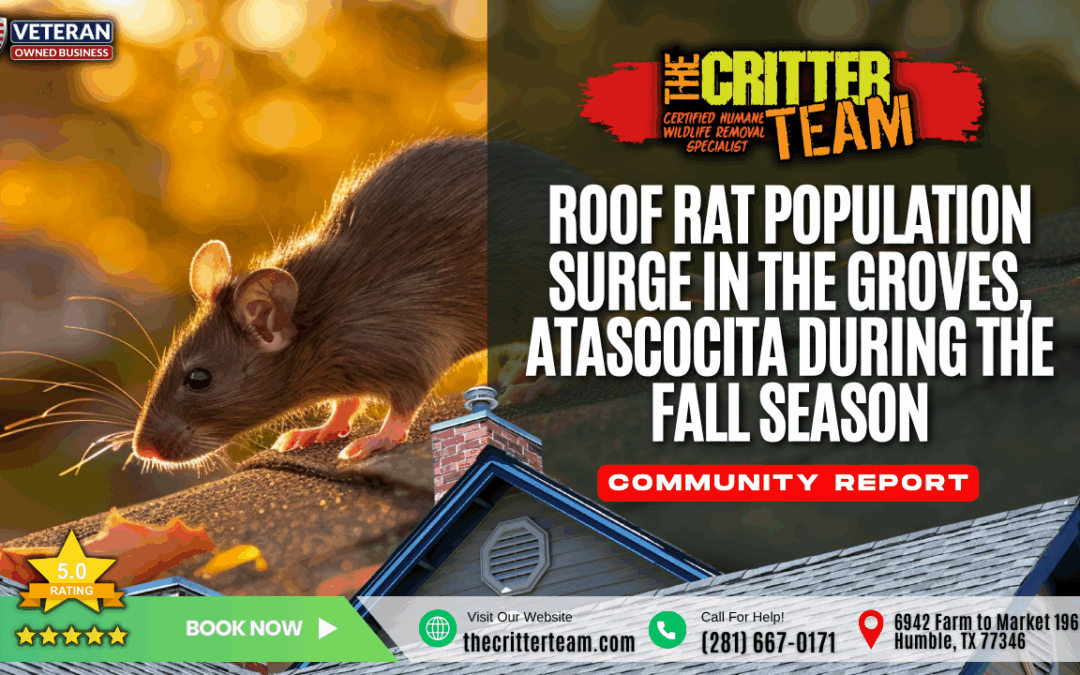
Roof Rat Population Surge in Atascocita, TX During the Fall Season
Short answer: the roof rat population in Atascocita climbs sharply through the fall as outdoor breeding peaks, juveniles disperse, and the entire local population shifts indoors for the winter. By late fall and into early winter, the rats inside attic cavities have established travel paths, are producing winter litters, and are doing the chewing damage on wiring and ductwork that drives most local service calls. Atascocita is a relatively new master-planned community with mature landscaping and plenty of food sources, all of which support a steady year-round roof rat population.
If you have heard nighttime scratching above the ceiling or found small dark pellets on top of a wall plate, the fall surge is already affecting your home. We handle Humble, Texas roof rat removal company calls from Atascocita following the same seasonal patterns every year since the company was founded in 2015.
Why the Population Surges in Fall
Roof rat numbers in the Houston area follow a steady curve through the year, but fall produces the sharpest visible jump. Three things drive the surge:
- Outdoor breeding peaks in late summer and early fall, producing waves of juveniles that disperse into surrounding territory
- Reduced outdoor food availability as the season progresses, pushing rats toward the consistent food and shelter that residential properties provide
- The pull of warm attic cavities as outdoor temperatures cool, drawing rats inside for the winter
The result is a population that is both larger and more visible than at any other point in the year. By the time most homeowners notice the activity, the migration into attics is well underway.
Why Atascocita Sees Heavy Pressure
Atascocita sits in a wooded section with mature trees, irrigated common areas, and proximity to greenbelt corridors that support a strong year-round roof rat population. The two-story brick homes that make up most of the neighborhoods have dormer-heavy rooflines and the typical wear points roof rats exploit. Pecan and oak drop in the surrounding canopy supports the outdoor population, and once the migration begins the attics fill up fast.
The greenbelts also give rats travel routes between yards. Once a colony establishes in one home, neighboring homes start seeing activity within a few weeks.
Our service in Atascocita, TX has worked this area since the company was founded in 2015 by Mike Garrett, a retired U.S. military veteran. Our field crews handle every job in-house from inspection through warranty-backed exclusion.
What the Indoor Population Is Doing Right Now
By late fall, the rats that have moved into local attics are no longer commuting from outdoor nests. They have committed to the indoor space and the behavior changes accordingly:
- Travel paths are fixed. Greasy rub marks build along the rafters and the tops of wall plates
- Nest construction is heavy. Insulation gets pulled into corners and shredded for bedding
- Breeding accelerates. Warm attic temperatures keep reproduction going year-round
- Food caches appear. Pecans, acorns, and pet kibble stashed in attic corners
- Wiring damage compounds. Constant chewing on cable insulation and PVC water lines
The Eight Entry Points That Account for Most Local Jobs
A roof rat skeleton compresses through any gap larger than a dime:
- Soffit-to-roof transitions on dormers and second-story tie-ins
- Plastic roof vents and turbine bases brittled by Texas heat
- Gable louvers with separated screen
- Brick weep vents, dime-sized openings before any modification
- AC line chases where the foam collar has shrunk
- Plumbing stack boots with cracked rubber from UV exposure
- Garage door bottom seals worn down at the corners
- Rotted fascia behind clogged gutters
Important: Sealing entry points before the rats are removed traps them inside the wall or attic. Dead rats in insulation become an odor and decontamination problem far worse than the original infestation. Removal first, exclusion second. Always.
This is where field experience makes a difference. We use 23-gauge aluminum fabricated on-site with a metal brake and painted to match the home, not spray foam, not steel wool, not off-the-shelf patches.
Health and Property Concerns
The CDC documents several diseases directly transmitted by rodents, including leptospirosis and salmonellosis. Both spread through droppings, urine, and contaminated surfaces. Roof rats also chew constantly on wiring, which is a real fire risk that insurance adjusters in the Houston area routinely cite. The longer the population stays in the attic, the bigger both concerns become.
Warning Signs of an Established Population
- Multiple droppings along the same travel path
- Greasy rub marks on rafters and the tops of wall plates
- Shredded insulation with established tunnels
- Chewed wiring with bare copper visible
- Night noise in the same location every night
- Heavy musk odor in the attic or upper rooms
What a Real Roof Rat Job Looks Like
We handle roof rat work as a complete sequence:
- Full inspection. Attic, foundation line, roofline, every vent and penetration. Photos of every entry point and every sign found.
- Trapping on the active runs. Humane live and snap methods placed where the rats actually travel. No poison and no kill traps.
- Exclusion work. Every opening sealed with rodent-proof materials including copper mesh, galvanized hardware cloth, and fabricated 23-gauge aluminum on roofline transitions. No spray foam and no steel wool.
- Decontamination. Soiled insulation removed, framing sanitized, contaminated batts replaced.
- Written warranty. One-year and three-year warranty options on the exclusion work.
We run all of this in-house with our own certified technicians. No subcontractors. The same crew that inspects the attic also handles the trapping, fabricates the metal on-site, and completes the cleanup.
What You Can Do This Week
Trim limbs back at least three feet from the roof.
Pull bird feeders at dusk or move them to a pole away from the structure.
Pick up fallen pecans, acorns, and ornamental fruit on a schedule.
Replace plastic roof vents with the heavier galvanized powder-coated versions.
Latch trash lids instead of bungee-cording them.
For a full property inspection, we can walk the roofline, inspect the attic, and get a crew on-site within a day or two.
If you are looking for roof rat trapping services in Humble, contact The Critter Team in Atascocita, Humble, Texas today at (281) 667-0171
The Critter Team
6942 FM 1960 Rd E, Suite 211
Humble, TX 77346
(281) 667-0171

📍 Atascocita, Humble, TX
Call today if you are in need of a roof rat control in Atascocita, Humble
The Critter Team
6942 FM 1960 Rd E, Suite 211
Humble, TX 77346
(281) 667-0171
Check out our other roof rat related articles:
Roof rat activity Kings River Village Kingwood, TX fall health concerns & Roof rat activity Eagle Springs Humble, TX fall
Frequently Asked Questions
Why does the roof rat population surge in fall?
Outdoor breeding peaks in late summer and early fall, producing waves of juveniles that disperse into surrounding territory. Reduced outdoor food availability and the pull of warm attic cavities then push the entire local population indoors for the winter. The result is a population that is both larger and more visible than at any other point in the year.
Will the population thin out on its own after the holidays?
No. Roof rats that have committed to a winter nest do not leave on their own. They breed inside, the population grows, and the contamination footprint expands. A manageable late-fall infestation often grows into a much bigger problem by spring. The right time to address it is when the noise first becomes noticeable.
Can I poison the rats to thin the population?
We do not use poison under any circumstances. Poisoned rats die in wall cavities and create odor and decontamination problems worse than the original infestation. Poisons also pose risks to pets and non-target wildlife including owls, hawks, and other natural predators that help control rodent populations. The right approach is trapping combined with full sealing of every entry point.
Is the wiring fire risk really significant?
Yes. Roof rats chew constantly to keep their incisors filed, and electrical wiring is one of the most common targets. Stripped wires sitting against blown-in insulation create ignition conditions that insurance adjusters in the Houston area routinely cite. This is one of the main reasons rodent removal cannot be put off indefinitely.
How long does the work take from inspection to finished cleanup?
For a typical home with a moderate infestation, initial trapping and entry point sealing takes about one to two weeks from the first visit. Decontamination and insulation replacement, when needed, add a few more days. Heavily infested attics or jobs with multiple species run longer. The written warranty starts the day the work is finished.